





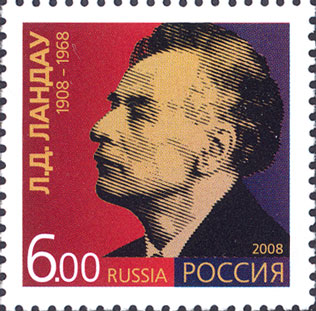
Lev Davidovich Landau (22-01-1908 – 01-04-1968) was a prominent Soviet physicist who made fundamental contributions to many areas of theoretical physics. His accomplishments include the co-discovery of the density matrix method in quantum mechanics, the quantum mechanical theory of diamagnetism, the theory of superfluidity, the theory of second order phase transitions, the Ginzburg-Landau theory of superconductivity, the explanation of Landau damping in plasma physics, the Landau pole in quantum electrodynamics, and the two-component theory of neutrinos.
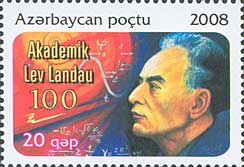
He received the 1962 Nobel Prize in Physics for his development of a mathematical theory of superfluidity that accounts for the properties of liquid helium II at a temperature below 2.17 K (−270.98 °C).

