





On July 8, 2008, the World Heritage Committee decided to add Prasat
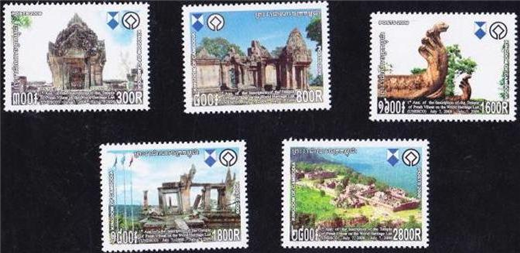
Preah Vihear, along with 26 other sites, to the World Heritage Site list. One year later, on July 07, 2009, Cambodia post issued a set of five stamp to commemorate this very important event.
The Preah Vihear Temple or Prasat Preah Vihear is a Khmer temple situated atop a 525-metre (1,720 ft) cliff in the Dângrêk Mountains, in the Preah Vihear province of northern Cambodia and near the border of the Kantharalak district (amphoe) in the Sisaket province of eastern Thailand. In 1962, following a significant dispute between Thailand and Cambodia over ownership of the temple, the International Court of Justice (ICJ) in The Hague awarded the ownership to Cambodia.
Affording a view for many kilometers across a plain, Prasat Preah Vihear has the most spectacular setting of all the temples built during the six-centuries-long Khmer Empire. As a key edifice of the empire's spiritual life, it was supported and modified by successive kings and so bears elements of several architectural styles. Preah Vihear is unusual among Khmer temples in being constructed along a long north-south axis, rather than having the conventional rectangular plan with orientation toward the east. The temple gives its name to Cambodia's Preah Vihear province, in which it is now located, as well as the Khao Phra Wihan National Park which borders it in Thailand's Sisaket province, through which the temple is most easily accessible.

Construction of the first temple on the site began in the early 9th century; both then and in the following centuries it was dedicated to the Hindu god Shiva in his manifestations as the mountain gods Sikharesvara and Bhadresvara. The earliest surviving parts of the temple, however, date from the Koh Ker period in the early 10th century, when the empire's capital was at the city of that name. Today, elements of the Banteay Srei style of the late 10th century can be seen, but most of the temple was constructed during the reigns of the Khmer kings Suryavarman I (1002 -1050) and Suryavarman II (1113 -1150). An inscription found at the temple provides a detailed account of Suryavarman II studying sacred rituals, celebrating religious festivals and making gifts, including white parasols, golden bowls and elephants, to his spiritual advisor, the aged Brahman Divakarapandita. The Brahman himself took an interest in the temple, according to the inscription, donating to it a golden statue of a dancing Shiva. In the wake of the decline of Hinduism in the region the site was converted to use by Buddhists.
The temple complex runs 800 m (2,600 ft) along a north-south axis, and consists essentially of a causeway and steps rising up the hill towards the sanctuary, which sits on the clifftop at the southern end of the complex (120 m/390 ft above the northern end of the complex, 525 m/1,720 ft above the Cambodian plain and 625 m/2,050 ft above sea level). Although this structure is very different from the temple mountains found at Angkor, it serves the same purpose as a stylised representation of Mount Meru, the home of the gods.
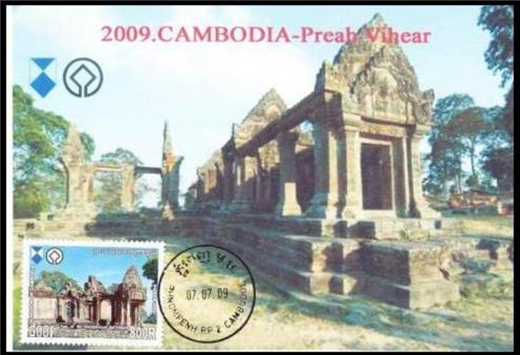
The approach to the sanctuary is punctuated by five gopuras (these are conventionally numbered from the sanctuary outwards, so gopura five is the first to be reached by visitors). Each of the gopuras before the courtyards is reached by a set of steps, and so marks a change in height which increases their impact. The gopuras also block a visitor's view of the next part of the temple until he passes through the gateway, making it impossible to see the complex as a whole from any one point.
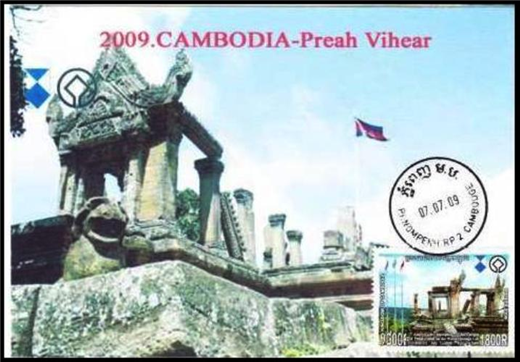
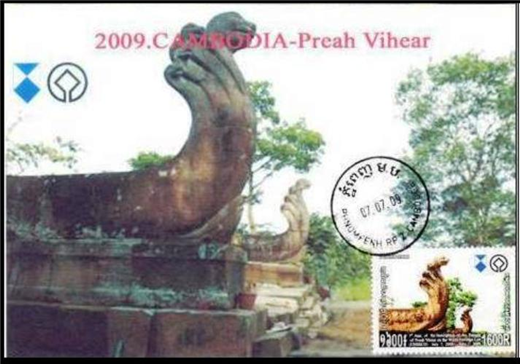
The fifth gopura, in the Koh Ker style, retains traces of the red paint with which it was once decorated, although the tiled roof has now disappeared. The fourth gopura is later, from the Khleang/Baphuon periods, and has on its southern outer pediment, "one of the masterpieces of Preah Vihear" (Freeman, p. 162) : a depiction of the Churning of the Sea of Milk. The third is the largest, and is also flanked by two halls. The sanctuary is reached via two successive courtyards, in the outer of which are two libraries.
The 2008 stand-off between Thailand and Cambodia began in June as the latest round of a century-long dispute involving the area surrounding Preah Vihear Temple between the Kantharalak district (amphoe) in the Sisaket province of eastern Thailand and the Choam Khsant district in the Preah Vihear province of northern Cambodia. Thailand claims that demarcation has not yet been completed.The dispute widened in 2008 to include the Ta Moan Thom complex 153 km to the west, near the border between the Thai Surin province and the Cambodian Oddar Meancheay province. Though some sources suggest otherwise, the Sdok Kok Thom Temple in Thailand's Aranyaprathet District is unlikely to become a source of dispute, as it is 1.6 km inside Thailand at a well-demarcated, undisputed section of the boundary in a heavily settled area, unlike Preah Vihear and Ta Moan Thom.
The stamp set of The Preah Vihear Temple
The Preah Vihear Temple or Prasat Preah Vihear is a Khmer temple situated atop a 525-metre (1,720 ft) cliff in the Dângrêk Mountains, in the Preah Vihear province of northern Cambodia and near the border of the Kantharalak district (amphoe) in the Sisaket province of eastern Thailand. In 1962, following a significant dispute between Thailand and Cambodia over ownership of the temple, the International Court of Justice (ICJ) in The Hague awarded the ownership to Cambodia.
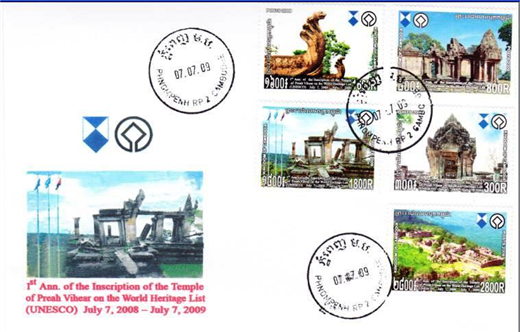
First day cover
Document
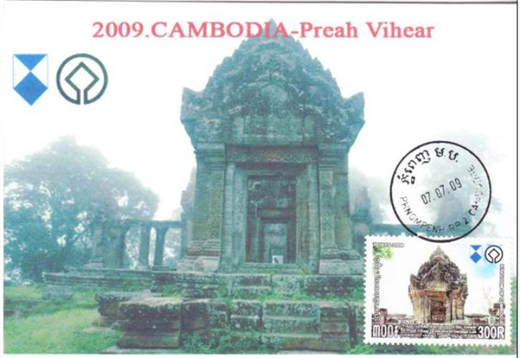
Maxicard 1
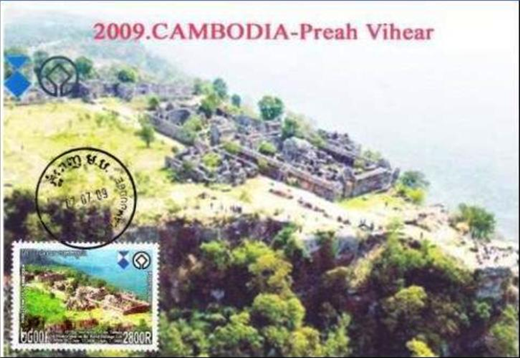
Maxicard 2
Maxicard 3
Maxicard 4
Maxicard 5
Wikipedia

